Ganga Sagar poster for sale.
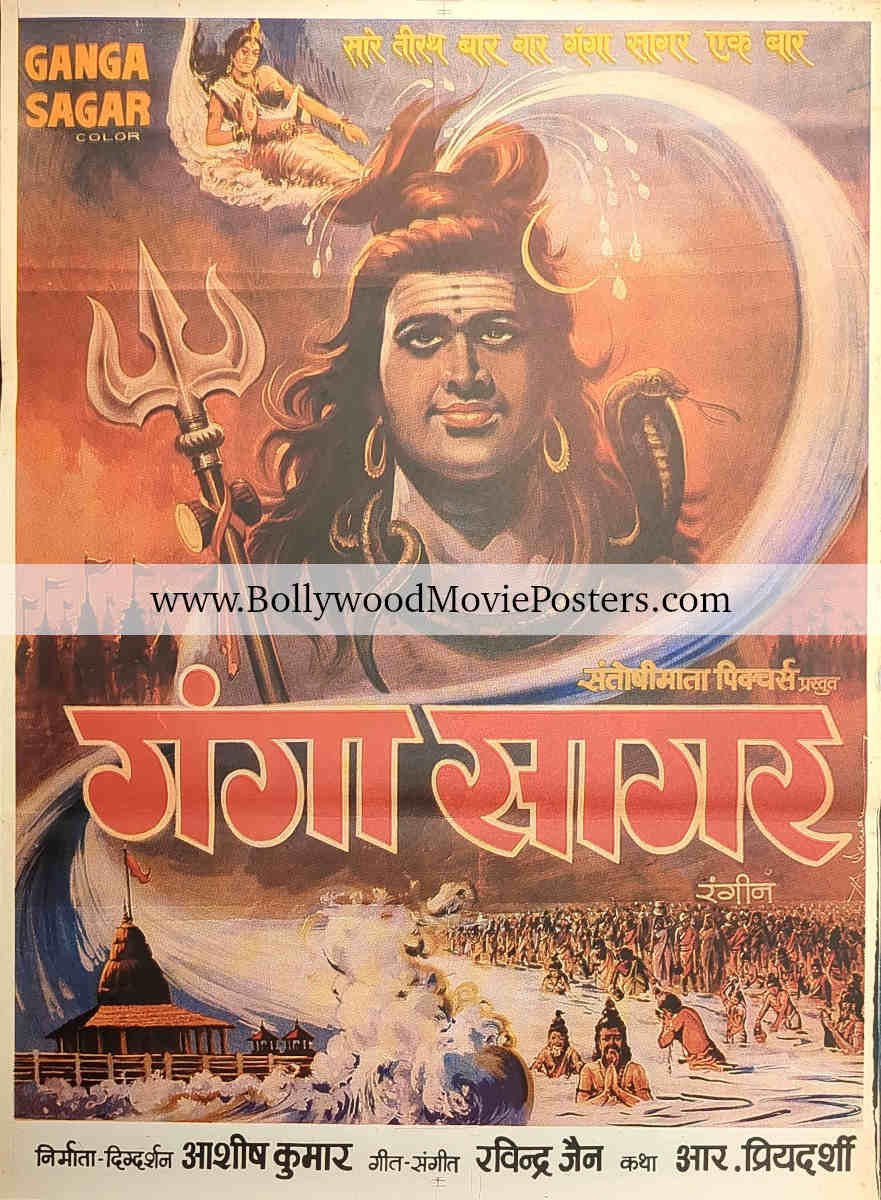
Featured here is an actual surviving old Bollywood poster of the 1978 mythological Hindi film produced and directed by Asis Kumar that also featured him in the lead role along with Bela Bose.
Released under the Santoshi Mata Pictures banner, Ganga Sagar (1978) also starred Trilok Kapoor, Bharat Bhushan, Lalita Pawar, Jayshree T., Abhi Bhattacharya, B.M. Vyas, Bhagwan Dada, Asha Potdar, Ratna Bhushan, Polson and Johnny Whisky in supporting roles.
The pioneer of special effects in Indian cinema, Babubhai Mistry lent his expertise towards the trick shots featured in Ganga Sagar (1978).
A Hindu devotional film, the story of Ganga Sagar (1978) was based on the sacred power of the holy river Ganges. The creator of the universe, Lord Brahma writes the destiny of Amar Singh (Asis Kumar), who is the son of wealthy landlord Vikram Singh (Trilok Kapoor) from Shyampur. Amar is appointed an early death due to the astrological timing of his birth. On the day of the first Makar Sankranti (Hindu harvest festival) after Amar gets married, he is destined to die. When Lord Brahma reveals the same to his son Narad Muni, Narad implores his father to find a way out to save Amar. The Gods in the heavens agree that what is destined must come to pass and cannot be reversed. Amar is fearless and full of virtue and righteousness. A devoted son, he is a just landlord who safeguards the rights of the poor. After his mother’s demise, Amar has been raised solely by his father and is indebted to his love. He chooses to remain a bachelor as he does not want a woman to create a divide between them.
Padmavati is a beautiful, virtuous woman who is an ardent worshiper of the sacred Ganges river. Her parents do everything in their power to find a suitable match for her. Thakur Bhero Singh agrees to get his son Sher Singh married to Padma on one condition: a dowry of five thousand rupees must be paid. Reluctantly, Padma’s father Thakur Pratap Singh (Bharat Bhushan) agrees. He asks Lala Chiranjilal for a loan of five thousand. Lala desires to have Padma for himself and devises an evil plot to trap Pratap Singh into marrying off his young and beautiful daughter to him. Lala assures Pratap that he will arrive with the dowry amount on the wedding day. Amar and Sher Singh are friends and he arrives for their wedding. Lala arrives at the wedding as well but with a shocking revelation. He declares in front of everyone present at the wedding that he has not come to give Pratap Singh the dowry amount of five thousand but rather to recover an amount of ten thousand rupees, which he falsely claims was a loan he gave to Pratap two years ago. In front of his entire community and village, Pratap Singh is both humiliated and branded a liar. Thakur Bhero Singh and his son Sher Singh call off the wedding and walk out. Pratap Singh is devastated. Lala now moves in to fulfill his plan by asking for Padma’s hand in marriage. When Pratap Singh refuses to give in to his evil design, Lala announces that he has power to repossess his home, as it was mortgaged against the outstanding loan. As Lala’s henchmen begin to empty Pratap’s home and evict the family, Amar steps in to save them. He offers his expensive pearl necklace as payment for the outstanding loan and clears Pratap Singh’s debt. Amar is hailed as a god by everyone present. He then asks for a righteous man to step forward and save Padma’s honor by marrying her. However, everyone refuses, citing that it is dishonorable for a man to marry a woman who has been rejected by her groom-to-be. Furious, Amar proclaims that humanity is dead in the village. Lala challenges him that it is easy to part with wealth and preach righteousness. If Amar really is godly as people claim him to be, he must prove it by marrying Padma. Left with no choice but to practice what he preaches, Amar breaks his vow of bachelorhood and agrees to marry Padma. Will Padma’s fervent devotion to sacred river Ganges help Amar escape his destiny of early demise?
Printed and circulated during a subsequent release run of the film (somewhere in the late 1980s), this Ganga Sagar poster was printed for publicity of the film in north Indian theaters but never ended up being used.
This Indian mythology poster was originally designed in hand painted oil on canvas format by a Bollywood poster design studio and features striking artwork.
The holy Ganges river is seen flowing from Lord Shiva’s hair in a stunning hand drawn illustration that dominates the poster. Lord Shiva is depicted carrying the Trishul (trident or three pronged spear), while serpent king Vasuki appears coiled around his neck. A hand painted portrait of Goddess Ganga giving her blessings appears at the top. Several Hindu sages are seen bathing in the holy Ganga river at the bottom, while Hindu temples are seen in the backdrop of this old Bollywood poster.
Typography used in this Ganga Sagar poster is entirely in Devanagari Hindi, except for a translation of the title in English and the word Color, which appear together on the top left. The main Devanagari Hindi title appears in a striking red font encased in a white border at bottom of this vintage Bollywood poster.
A line at the top announces the lyrics of a popular hymn from the movie, “Saare Tirath Baar Baar, Ganga Sagar Ek Baar” (The spiritual merit gained from visiting all other holy places multiple times can be achieved by visiting Ganga Sagar just once).
The soundtrack album of Ganga Sagar (1978) was composed and written by noted music composer Ravindra Jain.